


Article
Automated Mapping of Electronic Data Interchange (EDI): How Boomi AI is Eliminating the Manual Intervention
As we move through 2026, the integration landscape has fundamentally shifted. The introduction of Boomi AI has transitioned EDI from a manual configuration task to an automated, strategic function. A shift Aspire Systems is actively enabling customers through AI-augmented integration modernization programs.
The Strategic Constraints and Manual EDI Mapping
The legacy approach to EDI mapping is increasingly incompatible with the demands of the modern, high-velocity supply chain. Organizations relying on manual processes consistently face three primary challenges:
- Extended Time-to-Value: Onboarding a new trading partner typically requires weeks of manual field-to-field mapping and rigorous testing, delaying revenue generation.
- High Total Cost of Ownership (TCO): The scarcity of EDI specialists necessitates high operational expenditure, as skilled developers spend hours on repetitive, low-value configuration.
- Operational Fragility: Manual maps are inherently brittle. Minor schema changes from a partner often result in systemic failures, requiring immediate and costly remediation.
How Does Boomi AI Move Integration from Manual Configuration to Intelligent Automation?
Boomi AI leverages generative AI and expansive metadata patterns to transform the integration lifecycle. By shifting the burden of syntax and structure from the developer to the platform, Boomi is redefining the "Art of the Development" in B2B integration.
1. Accelerated Design via Natural Language (Boomi Design Gen)
Boomi AI allows architects to bypass the initial "blank canvas" phase. By using natural language prompts, developers can generate baseline integration patterns and mappings instantly.
Example: A request to "Map an inbound X12 850 Purchase Order to a NetSuite Sales Order" triggers the AI to analyze historical patterns and industry standards, producing a high-fidelity starting point in seconds rather than days.
2. Intelligent Mapping and Predictive Suggestions
Drawing on billions of anonymized integration points, Boomi Suggest provides intelligent field-level mapping recommendations. In 2026, this has evolved into context-aware mapping, where the AI anticipates business logic such as complex date conversions or currency transformations based on the specific requirements of the industry vertical.
3. Resilience through Automated Documentation and Maintenance
One of the most significant risks in EDI is the loss of tribal knowledge. Boomi Scribe automatically generates comprehensive documentation for every mapping logic. Furthermore, AI-driven maintenance tools can now perform "impact analysis," predicting how a change in an ERP version will affect existing EDI flows, allowing for proactive adjustments rather than reactive troubleshooting.
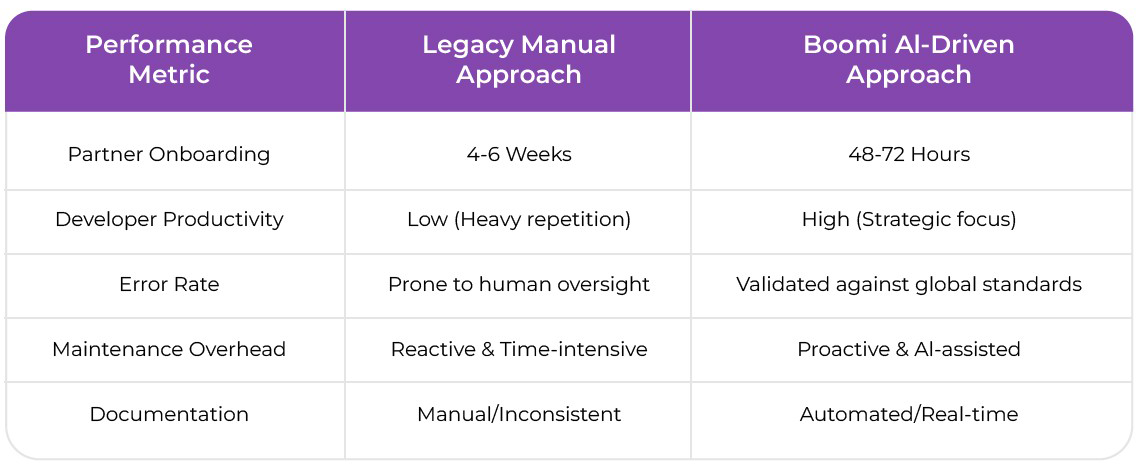
Performance Comparison: Manual vs. AI-Augmented EDI
Aspire System’s customer programs consistently demonstrate measurable improvements, including:
- Faster partner onboarding cycles
- Reduced manual exception handling
- Lower integration maintenance effort
- Improved auditability and compliance
Conclusion
The elimination of manual EDI mapping is not merely a technical upgrade; it is a strategic imperative. By leveraging Boomi AI together with Aspire Systems’ integration expertise, organizations can reduce integration backlogs, mitigate the risks associated with human error, and respond to market disruptions with near-instantaneous pivots.
In an era where the supply chain is a primary theatre of competition, the ability to automate the "handshake" between businesses provides a decisive edge. Aspire Systems ensures that Boomi-powered EDI automation is governed, scalable, and future-ready transforming integration from a bottleneck into a catalyst for growth.
Topics Covered
The strategic Constraints of Manual EDI Mapping
The Boomi AI Solution
Manual vs. AI-Augmented EDI
Conclusion


Boomi-Led Integration
Orchestrating Data, Applications, and Business Processes