


Data Democratization Is a Myth Without Metadata Management: Why AI-Ready Data Starts with Governance
Share this Article on


 TL;DR
TL;DR
Giving everyone dashboard access isn't data democratization; it's the illusion of it. Without metadata management (lineage, governed business definitions, automated cataloging), business users and AI agents alike can't tell if the data they're looking at is accurate, current, or even the right dataset. Enterprise AI initiatives inherit this ambiguity and amplify it at scale. Real data democratization requires treating metadata as core infrastructure, not documentation debt, which is exactly where Aspire Systems' Data & AI practice, built on the Databricks partnership and accelerators like FinEdgAI and BFS 360, focuses its governance work.
Democratized data is the trend, and every enterprise data would very much like to claim so, with the perfect dashboards for every department, self-service analytics at the disposal of every business user and AI Co-pilots answering queries in simple English. Although, this sounds like progress, all of it comes crashing down with a single question. Where did the numbers come from and how trustworthy are they?
Usually, the answer to this question is heavy silence, which in simple terms explains the real state of data democratization in most enterprises. Although the access is democratized, the understanding is still a long way to go. Hence, data democratization without metadata is just another jargon, not a capability that businesses can rely on.
The Uncomfortable Truth: Access Without Context Is Not Democratization
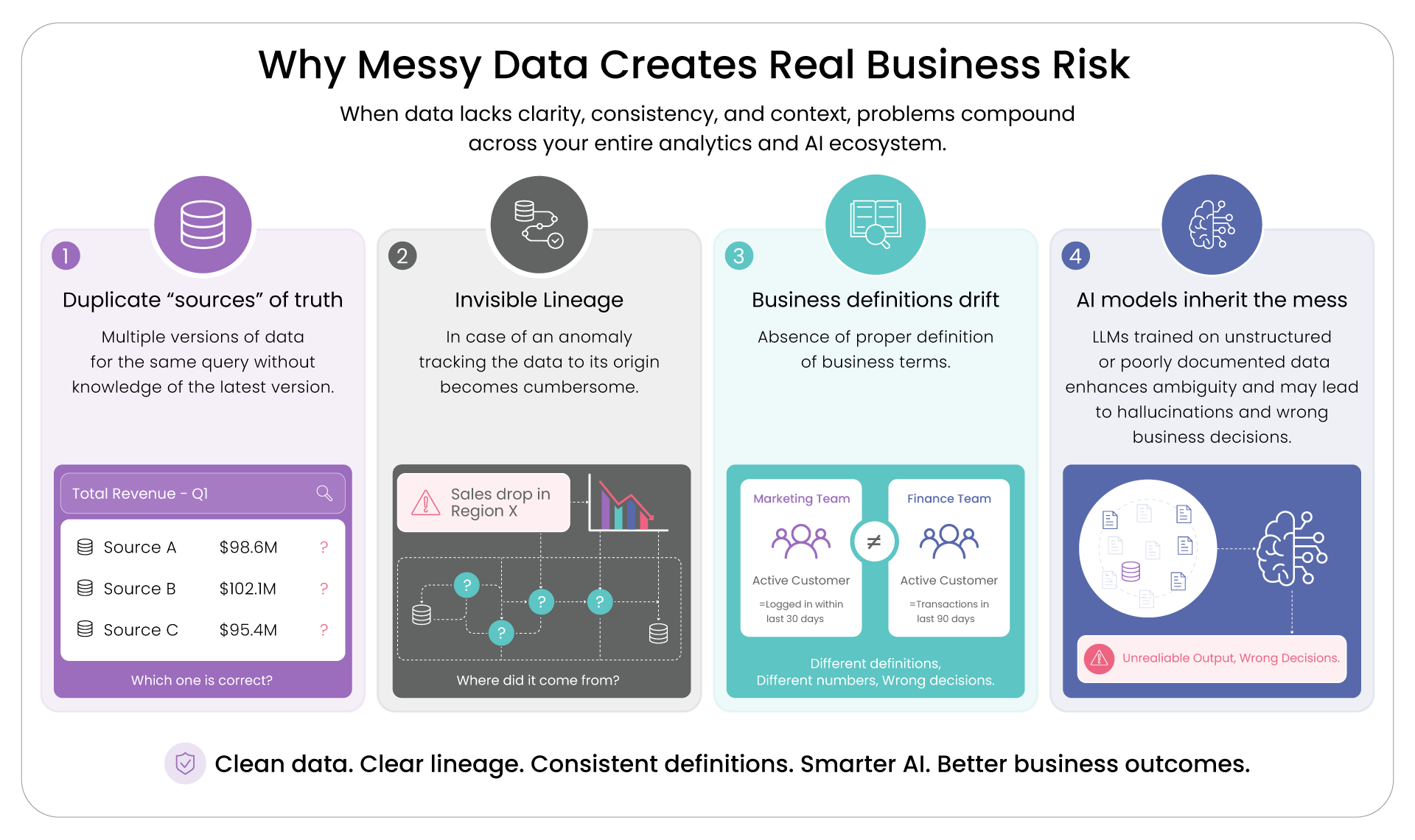
The repercussion of handing a self-service BI tool without reliable metadata can be quite far-fetching. They may find the data they were searching for after a few trials, but how will they figure out which version of the data they are supposed to use? The reasons why enterprises cannot treat metadata management as an afterthought are:
- Duplicate "sources of truth" - Multiple versions of data for the same query without knowledge of the latest version.
- Invisible Lineage – In case of an anomaly tracking the data to its origin becomes cumbersome.
- Business definitions drift — Absence of proper definition of business terms
- AI models inherit the mess – LLMs trained on unstructured or poorly documented data enhances ambiguity and may lead to hallucinations and wrong business decisions.
As enterprises move towards deploying AI agents for decision making rooted in enterprise AI governance frameworks, the assumption is often that more data access improves model intelligence. However, in reality, an AI system is only as trustworthy as the metadata layer beneath them.
Metadata Management: The Missing Infrastructure Layer
Metadata management is the infrastructure that makes data democratization possible. If done well, it delivers amazing results:
1. Active Data Lineage: It ensures that every dataset, dashboard and AI output is trackable back to its source and updated to the latest version enhancing trust in business users and improving AI reasoning justification.
2. Living Business Glossary: Technical data although important; the real gold is the business data which defines business logic and is the feed for every AI prompt. Metadata can give this data support and structure to enhance Agent performance and decision making.
3. Automated Data Cataloging: Manual metadata tagging can scale maximum to a few hundred tables, and it is impossible to scale the multi-cloud, multi-source environments most enterprises run today. AI-assisted, automated data cataloging built on Databricks Unity Catalog makes governance sustainable and reliant.
4. Governance Embedded on the Platform Level: The most winning strategy for an enterprise today is embedding metadata management, access policies and lineage tracking directly into the data platform itself. This enables the governance to scale at the same speed as data volume and AI adoption.
From Data Chaos to Data Trust
True data democratization is measured based on how quickly a business user or an AI agent adapts to the data found on their dashboard, assimilate it, understand the source and take actions without hallucinations.
This shift is possible only when metadata management is implemented as an enterprise asset and not as an afterthought. Enterprises that understand this simple strategy genuinely empower their data and reap enormous benefits out of it, including customer loyalty and trust.
How Aspire Systems Builds the Metadata Foundation Behind Real Data Democratization
We at Aspire Systems are familiar with this "democratization without governance" trap, across industries suffering from a single root cause. Our Data & AI practice is built specifically to bridge this gap, not by including another disconnected tool but by actually embedding metadata management, lineage and governance into the platforms our clients already run on.
Our partnership with Databricks has helped us implement automated data cataloging via Unity Catalog to a number of enterprises, establishing active lineage across complex multi-source environments. We have built governed business glossaries that keep AI-ready data genuinely AI-ready. Our proprietary accelerators across industries such FinEdgAI and BFS 360 for financial services, along with governance and data-quality tooling like SoftSpell and AFTA, are engineered to operationalize this trust layer quickly, rather than requiring a multi-year governance overhaul before any business value is realized.
Questions Worth Asking
As they say, 'the devil is in the details' and asking the right questions can give you the ultimate ROI for your investment and give you the competitive edge in the current landscape.
Q: What is the difference between data democratization and metadata management?
Data democratization refers to giving broader access to data across an organization, typically through self-service BI tools and dashboards. Metadata management is the discipline of documenting, organizing, and governing information about that data. It defines it's source, definitions, lineage, and quality. Access without metadata management creates the illusion of democratization without the substance of it.
Q: Why does poor metadata management undermine enterprise AI initiatives?
AI models and agentic AI systems are grounded in the data they're given. If that data lacks clear lineage, consistent business definitions, and quality signals, the AI inherits and amplifies the ambiguity; often producing confident, well-articulated answers that are quietly wrong. Enterprise AI governance depends on a reliable metadata layer to ensure model outputs can be traced, explained, and trusted.
Q: How does a data catalog improve data trust across an organization?
A data catalog centralizes metadata, its schemas, ownership, lineage, refresh cadence, and business definitions into a searchable, governed layer. This lets business users and AI systems alike find the right dataset, understand its context, and verify its origin before acting on it, replacing tribal knowledge and duplicate "sources of truth" with a single, governed reference point.
Q: What role does Databricks Unity Catalog play in metadata management?
Unity Catalog provides a unified governance layer across an organization's data and AI assets, enabling automated cataloging, fine-grained access control, and end-to-end lineage tracking across clouds and workspaces. For enterprises pursuing AI-ready data at scale, it reduces the manual overhead of metadata management while embedding governance directly into the platform where data and AI workloads run.
In This Article
- The Uncomfortable Truth
- Metadata Management: The Missing Infrastructure Layer
- From Data Chaos to Data Trust
- How Aspire System Builds the Metadata Foundation
- Questions Worth Asking